
Elemonsters: Worth knowing
Element Spectrum
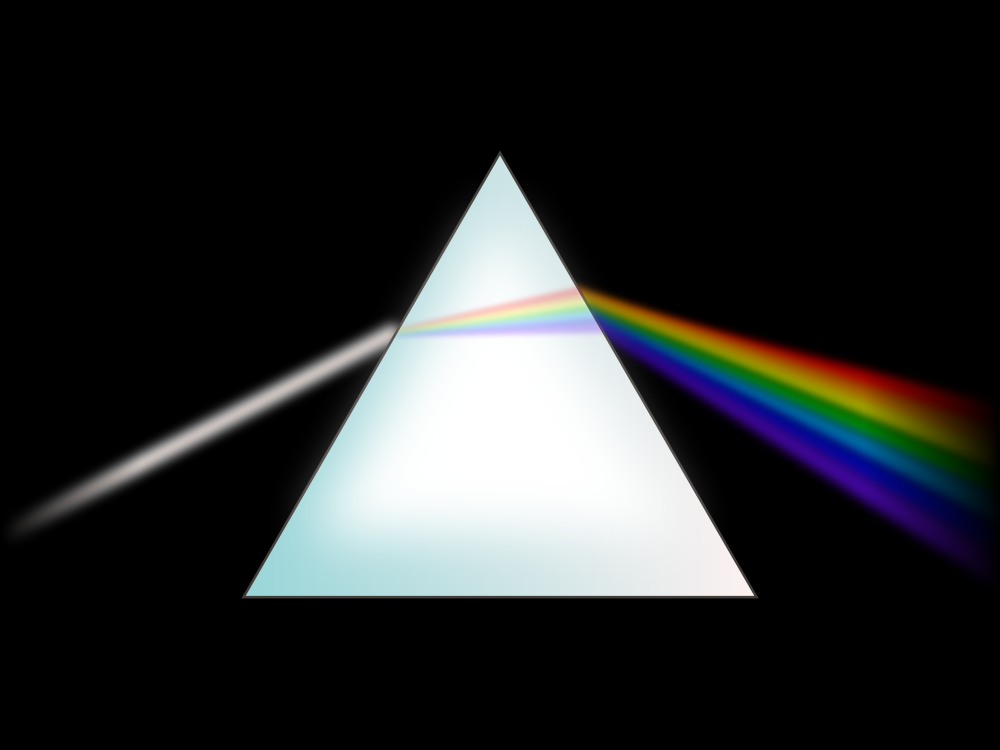
Every element has what is known as an emission spectrum. This arises when an element in the gaseous state is excited to glow (for example by electrical voltage). A typical example of this are energy-saving lamps, in which mercury vapor glows. Any light can be broken down into its components – for example with a prism (see illustration). White light consists of all the colors of the rainbow. This is referred to as the light spectrum, the totality of all visible colors. Now, when an element is made to glow, its light is composed of only very specific hues. This composition of colors is different for every element.

Sodium vapor lamps glow yellow. The spectrum clearly shows a yellow line.


Neon tubes glow red. The lines in the red range are not quite as clearly visible.

One could therefore also speak of a "visual fingerprint," since an element can be recognized anywhere by its characteristic spectrum – even in space. This allows astronomers to determine which elements stars are made of. In this way, for example, the element helium was discovered in the Sun before it could be detected on Earth. You can easily try this out yourself using a hand-held spectroscope (which can be ordered here, for example).
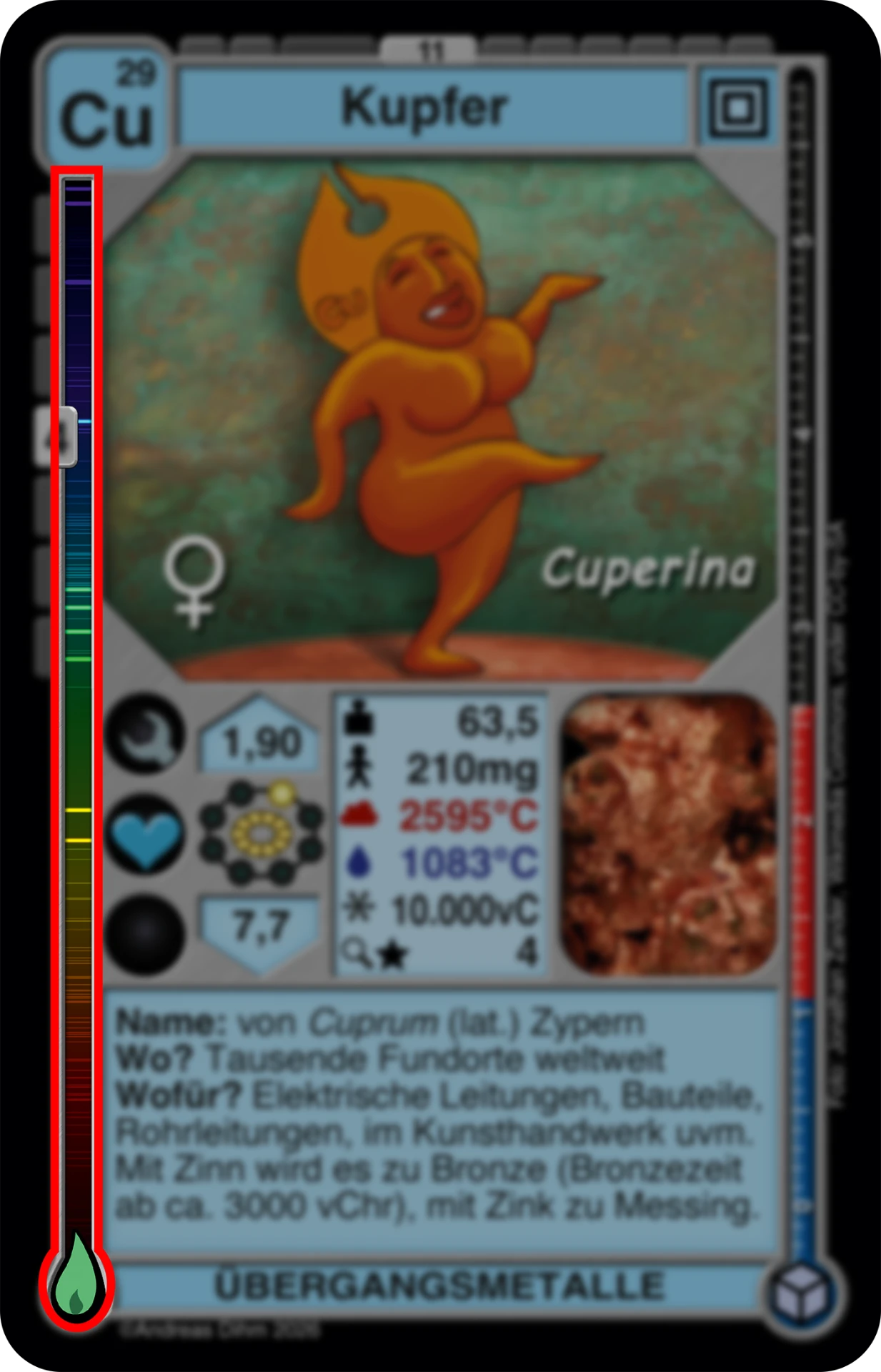
In the Elemonsters card game this spectrum is shown on the left side as a long, vertical strip (set against the colors of the rainbow). Each small line represents one hue. Some have very many thin lines, some have few thick ones, but the strip looks different every time.
Light consists of electromagnetic waves. Every wave – including every hue of light – has a frequency, just like the sound waves we can hear, only much higher. If these frequencies are now converted – by simple division – visible hues can be turned into audible tones. This process is called sonification. The tones can be heard in the app by clicking on the icon with the musical note on the rainbow.

The fact that sometimes many more tones can be heard than lines can be seen is because there are also (light) waves that our eyes cannot perceive (such as infrared light or ultraviolet light). The entire spectrum of an element is thus much larger than what we can see. Visible light is ultimately only a small part of the electromagnetic spectrum, which ranges from radio waves through X-rays to gamma rays. Side note: The range of visible light spans less than one octave, whereas the range of all audible tones spans up to ten octaves (depending on age).
Example sonification of copper (the tones are not yet synchronized with the highlighting of the lines):
Thanks to Marc Lingk for the sonification of the elements.
Rarity value
* Rarity value: this is a simplified, logarithmic representation of how common an element is on Earth. Roughly speaking: how many digits after the decimal point does its share of the Earth's crust have?
- Oxygen has a rarity value of 1. Its share of the Earth's crust is 49.4 %, roughly 0.5 (one half) — one digit after the decimal point.
- Gold has a rarity value of 9. Its share of the Earth's crust is 0.0000005 % or, as a decimal, 0.000000005 (five billionths, 5×10⁻⁹) — nine digits after the decimal point.
Electron Shell
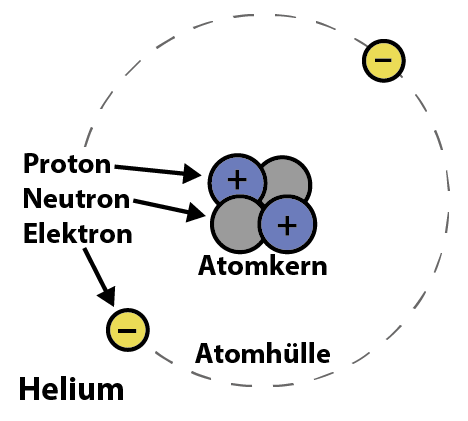
An atom consists of a nucleus and a shell. The nucleus, in turn, consists of protons and neutrons, while the shell consists of electrons. Protons are positively charged, electrons are negatively charged, and neutrons – as the name already suggests – are neutral.
The number of protons in an atom determines which element it belongs to: hydrogen contains one proton, helium two protons, lithium three, and so on. This is also called the atomic number (in the card game it is the small number to the upper right of the abbreviation in the box in the top left corner).
The number of electrons determines whether and how the atom is charged: if there are as many electrons as protons, the atom is neutrally charged. If there are more electrons than protons, the atom is negatively charged, and if there are fewer, it is positively charged. Charged atoms are called ions.
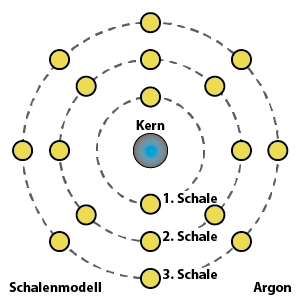
Depending on the number of electrons, the electron shell is divided into several layers, called shells, among which the electrons are distributed. Each shell can only hold a certain number of electrons. The Elemonsters card game shows a highly simplified version of the electron shell. Only the outermost shell is shown, since this is the most interesting one with regard to chemical bonds. With the exceptions of hydrogen and helium, the outermost shell can hold exactly eight electrons. These are called valence electrons. Put simply, an atom always strives to make its outermost shell either completely full or completely empty – whichever is easier. Noble gases such as argon (shown in the image alongside) already have a full outermost shell and therefore want neither to give up nor to take on electrons. Accordingly, they hardly form any bonds at all. So that they still play a role in the game, there is a separate category in which noble gas pairs can be played. There, each pair is even worth three points, because they are so rare.
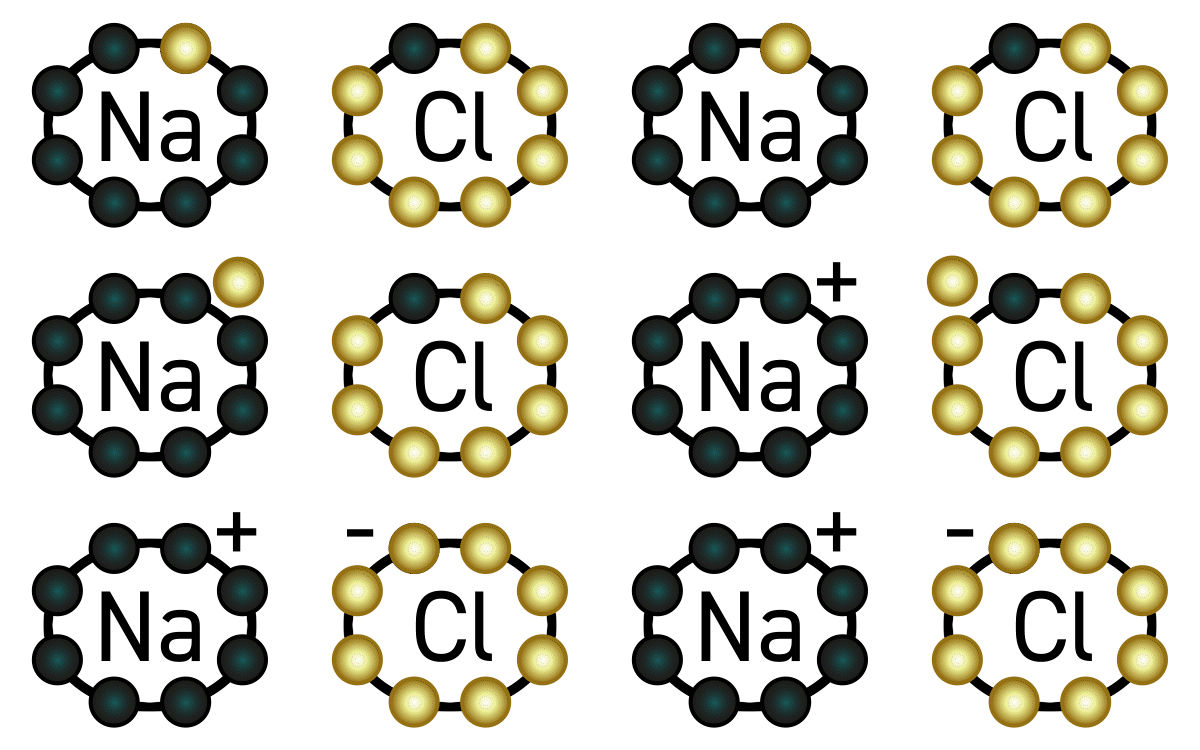
Example: Sodium has one electron in its outermost shell and is therefore happy to give one up. Chlorine has seven electrons in its outermost shell (so only one electron is missing to reach eight) and is therefore happy to take on one electron. It becomes apparent that these two elements are a wonderful match: sodium gives chlorine one electron, and both are happy. Now the following happens: as we read above, sodium now has one fewer electron in its shell and thereby becomes positively charged. Chlorine, in turn, has one more electron and thereby becomes negatively charged. Positive and negative attract each other: a bond is formed, more precisely an ionic bond, because sodium and chlorine have become ions. This compound is called sodium chloride – also known as table salt.
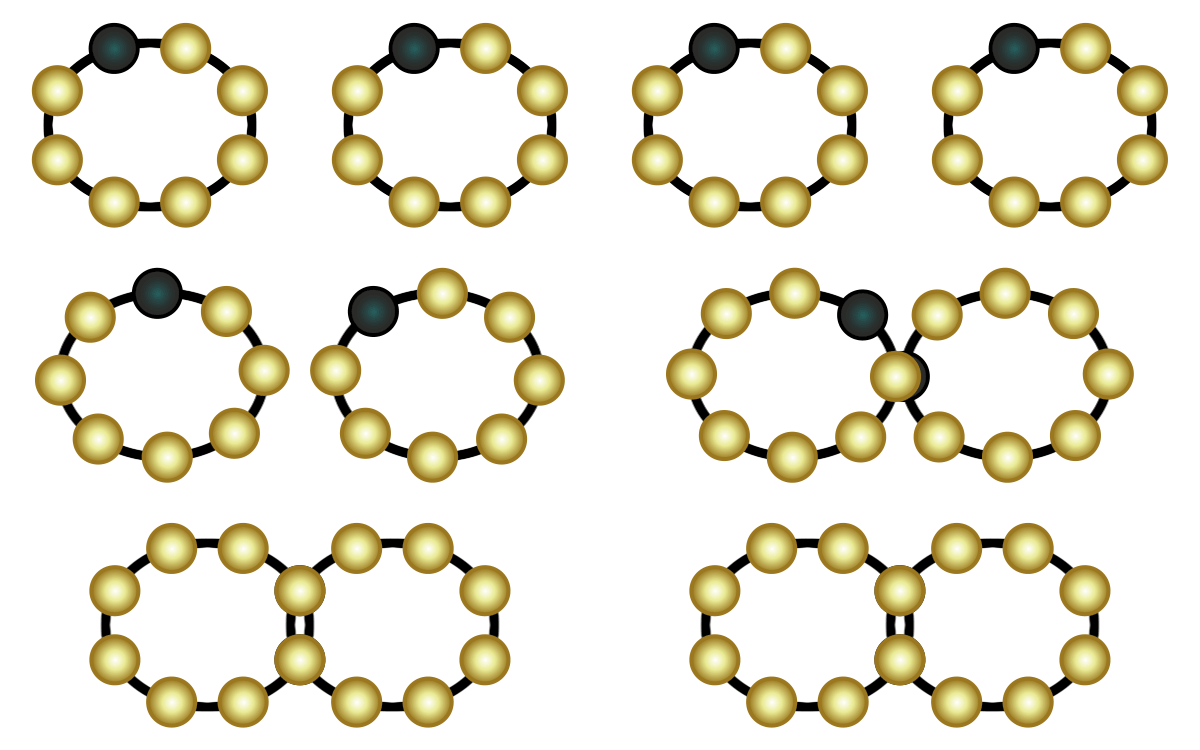
Another type of bond is the molecular bond. When two atoms each have a gap in their outermost shell, they can move so close together that their shells overlap. They then each share one electron, thus closing their gaps (this is illustrated in the animation on the right). This also works with two gaps (oxygen) and with three gaps (nitrogen).
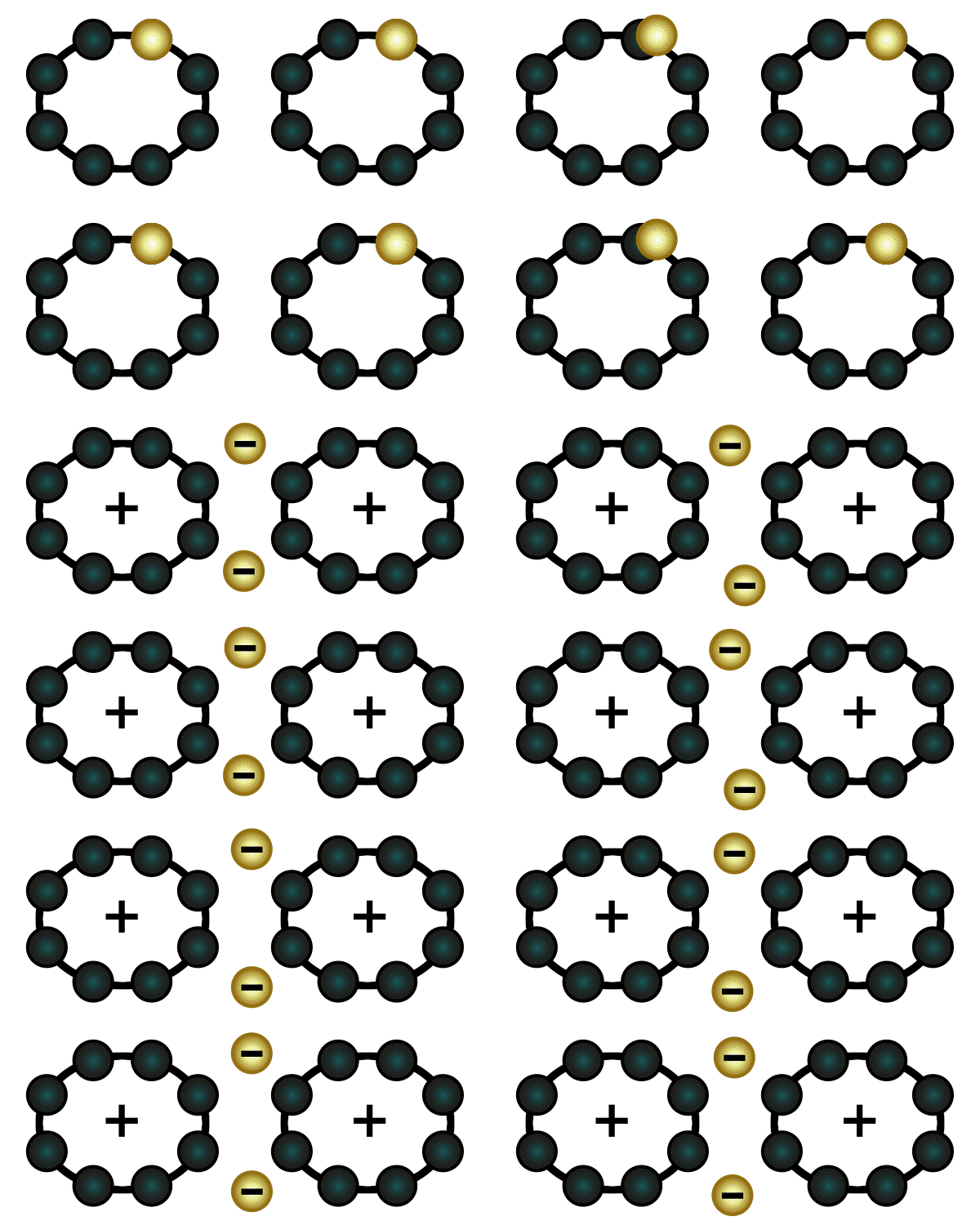
In alloys, what is known as metallic bonding comes into play. Atoms that have only few electrons in their outermost shell readily give them up. When several atoms of this kind come together, they form a lattice structure. The released electrons then move about more or less freely within this metal lattice, between the positively charged atoms. This is why it is also referred to as an "electron gas." It is responsible for the fact that metals conduct electricity well, since electric current is nothing other than electrons flowing through the metal.
In reality, the number of electrons in the outermost shell is not actually all that important for the bond. In principle, therefore, metals of very different kinds can be alloyed with one another. However, so that it is not too easy in the game, playing bonds is restricted to pairs with the same number of valence electrons.
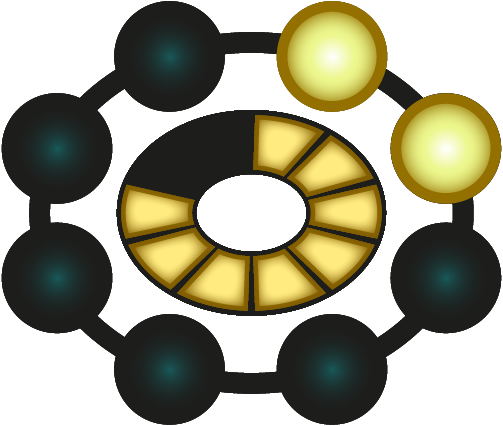
Some cards in the game have additional yellow dots inside their electron shell that look like pieces of pie and are not explained in the legend. These are elements from the group known as transition metals. These have an additional (underlying) electron shell that can hold up to ten electrons (in this example, nickel). This shell is of no importance for the game and serves only to depict the shell model correctly.
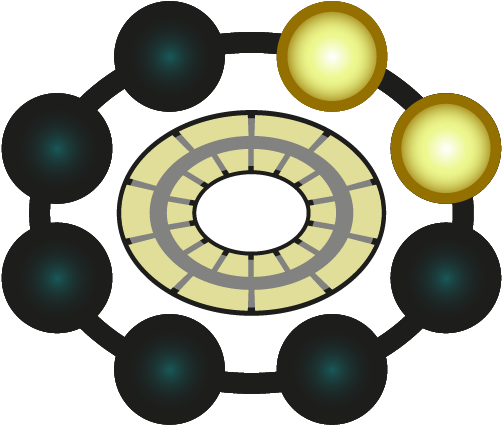
To make matters even more complicated, there is yet another category of elements, namely the lanthanides and actinides. These have yet another electron shell with up to 14 electrons. Since this would be too complicated to depict in the card game, it is symbolized by two concentric rings (in the card game this concerns the elements uranium and plutonium).